Hippies and Environment
Hippies and Environment
Earth's environment is undergoing changes that affect us all. There are climate change deniers, but most people are starting to believe the danger can no longer be ignored. Scientists overwhelmingly agree we have to change the way we interact with our environment if we want to bring climate change under control. Hippies became aware of the importance of mother nature long before the general population started waking up to the reality.
How did the hippies acquire such a love of the land? What caused so many of them to walk away from homes that were often secure and to look for meaning elsewhere? What made them so passionate about the environment?
Let's look again at American society of the 1950s and '60s, when Americans could finally put World War II behind them. What kind of country were those future hippies born into? Germany had surrendered on May 8, 1945. World War II finally ended when Japan formally surrendered on September 2, 1945. By the late '40s America was finally looking to the future. The 1950s and '60s held great promise.
 Baby Boom AmericaBaby Boom America
Following WWII, Americans wanted to focus on building families, starting businesses or getting good jobs that let them settle in and find comfort. Who wouldn't be looking for peace and quiet after what the entire country had just been through? But their children, the Baby Boom generation, weren't looking for peace and quiet. They hadn't lived through a war.
Like most children, the boomers grew up inquisitive, energetic, and ready to explore the world in front of them. Some boomers didn't see the appeal of a steady job, decent income, dinner with the family around the table each evening -- the Leave it to Beaver world that TV shows modeled. Some boomer kids saw that as a boring, unimaginative, and unchallenging lifestyle.
It's typical for children to look for challenge. How else would they grow? It's human nature to make a place for yourself in the world. The boomer generation was no different. Some liked the security and followed in the footsteps of their parents, going on to get jobs or higher education and professional careers. They were ready to start families of their own. America continued, in many ways, on the path that the WWII generation created.
But as in any society, there were outliers. There were those who weren't content to follow in the footsteps society laid out for them. There will always be "rebels," those who want to forge their own way, unencumbered by tradition. A lot of these free thinkers found the path that fed the hippie generation.
Much like the Beat Generation before them, some children born in the '40s, and '50s set out to explore the world on their own. Whatever their reasons, they weren't content with the path their parents were on. They looked at America and saw things they wanted to change.
Many who gravitated toward the hippie movement were looking for deeper meaning in life. In some ways it's ironic. If you're secure, you feel free to explore the world. You're not tied to a job, and you don't have the responsibility of caring for others. Maybe the security of American life opened the door for inquisitive youth to wonder, "What else is there to life?"
The hippies wanted more. In their exploration, many found Rachel Carson's book, "Silent Spring," published in 1962. Carson, a marine biologist and environmentalist, highlighted the dangers of synthetic pesticides that were polluting our waters. Although the U.S. chemical industry tried to discredit "Silent Spring," many people, including the hippies, listened.
 Rachel Carson - Silent SpringRachel Carson - Silent Spring
The dangers of polluted waters and endangered ecosystems were something the hippies could get behind. It was a movement that resonated with them. The hippie quest for deeper meaning and stronger connection included a desire to find their place in nature, to become one with the earth.
Those hippies understood that the earth sustains us. It's our home, and it's up to us to care for that home. They felt a deep connection with nature. As most of America turned to materialism, hippies turned to nature.
Rachel Carson's book blended science and advocacy, and her expose resonated with the hippies. They were ready to put their youthful energy to work with nature.
Many hippies joined together and worked to grow their own food. This gave them more freedom from the economy. Nature, rather than the local grocery store, provided their nourishment. This gave them a sense of freedom and let them feel more in control of their lives.
Respect for the environment and the land informed much of hippie ideology. The hippies who joined the back-to-the-land movement sought to live in harmony with the land and worked to protect the environment from pollution and waste.
Hippie communes sprang up across America where groups lived together and worked the land as a community. There were various forms of organization in different communes, but they generally depended on shared resources and labor to provide for their food. They made use of common kitchens and gardens and shared the labor. Whether they were aware of it or not, they were echoing a similar effort in the 1920s.
 Work and play on the landWork and play on the land
The hippies' goal was to live a simpler life, more connected to nature and not dependent on the fast-paced life of American society. Status, money and material goods just didn't appeal to the hippies. There are back-to-the-land communities in existence today, some with roots in the original hippie movement.
Hippies and their communes added to the call for greater environmental awareness in America. As hippies, and society in general, began to clamor for improvement in our environment, President Richard Nixon responded. He oversaw meaningful changes to America's environmental policies.
The major environmental legislation that came out of the Nixon Administration were the National Environmental Policy Act (NEPA, 1969), the Clean Air Act Amendments (1970), the Clean Water Act (1972), the Endangered Species Act (1973), and the Marine Mammal Protection Act (1972).
Nixon also created the Environmental Protection Agency (EPA) and helped establish the National Oceanic and Atmospheric Administration (NOAA). He launched the Legacy of Parks program, which converted 80,000 acres of federal land into recreational parks.
Hippie activism and back-to-the-land ideals were also a big part of the reason we celebrated the first Earth Day on April 22, 1970. The United States continues to celebrate Earth Day every year on April 22nd. Celebrated by 192 countries around the world, Earth Day is the world's largest environmental movement. Don't ever try to tell me the hippies didn't make a difference.
 Earth Day PinEarth Day Pin
Hippie Spirituality
Why did the hippies turn to spirituality in such large numbers? Why did many seek a spirituality so different from the religion they may have grown up with?
I don't know whether the hippies' love of nature and the land led them to spirituality or whether it was spirituality that started their quest. I guess you'd have to ask each individual how their journey began. But it's clear that there was a deep spiritual hunger within many in the hippie movement. Eastern religions fed that spirituality for many. Numerous popular musicians of the time incorporated Eastern religions into their work.
The Beatles were on the leading edge of introducing Transcendentalism through their music. They heard a London lecture by Maharishi Mahesh Yogi, the founder of the Transcendental Meditation (TM) movement in 1967 and became very interested in TM. The following year, they traveled to India to study TM in his ashram.
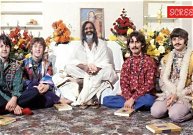 Beatles with Maharishi Mahesh YogiBeatles with Maharishi Mahesh Yogi
The Beatles were heavily influenced by the study of TM and their White Album was the result. Other musicians also studied with Maharishi Mahesh Yogi and became devotees of the movement.
You'll find influences of Transcendental Meditation in music by many musicians of the hippie era. Here's just a partial list: Donovan, The Beach Boys, The Doors, The Rolling Stones, Stevie Wonder, Sheryl Crowe, Cat Stevens and many others.
It wasn't just Transcendental Meditation that made its way onto the music scene. Other Eastern religions and meditation styles influenced the music of the era as well. Religions such as Hinduism, Buddhism, Taoism, and Sikhism were other spiritual programs popular among hippies.
Artists such as Janis Joplin, The Grateful Dead, Jimi Hendrix, and the Byrds were often a bridge between Eastern spiritual traditions and the hippie movement in America.
The simpler lifestyle that hippies were looking for was often found through music, meditation, living communally and working the land for sustenance. Personal connection with yourself and others is rewarding in its own right. Trying to understand the big questions, "Who are we?" and "What is our purpose?" can help us make connections with others who have those same questions.
There are those in our world today who say empathy is dead and caring for others is for suckers. But I believe the hippies were onto something. Learning to share space and respect those with whom we share it can only lead to the peace, love, and understanding the hippies were looking for all along. It's a world I choose to live in. I hope someday you will join us.